Accelerating lead conversion through contextual workflows, structured intelligence, and AI-assisted decision-making.
AI Co-Pilot
Enterprise SaaS
Automotive CRM
Overview
AutoNinja provides one unified CRM for automotive dealerships, replacing multiple point tools with a single platform that boosts conversion, tracks workforce productivity, and delivers intelligent insights.
02 - TEAM
Team
My Role: Associate Lead Designer, Led end to end design
Team: 3 PMs, 5 Engineers, 1 ML Engineer
Timeline: 4 Months, Nov 2025- Feb 2026
Owned: User research, AI Interaction Model, Design Sytem, Intercative Prototype
Collabrated on: Tag Taxonomy and Confidence Logic (ML Engineer) Pilot Instrumnetation (PMs)
03 - RESEARCH INSIGHTS
Research Insights
To understand the gaps, we ran early user interviews with 30+ Tele callers and 8 Dealership Principals exploring how they operate, manages and use data to take decisions.
KEY FINDINGS
Motivations
82% of participants were motivated by hitting call targets and maximizing lead conversions.
Needs
70% wanted to log customer interactions faster, with minimal effort.
Pain Points
Time pressure turns valuable customer insights into unstructured CRM data.
Motivations
Our research uncovered a fundamental gap that dealerships generated customer conversations every day, but existing workflows fail to turn them into structured data that teams and systems could act on.
03 - RESEARCH INSIGHTS
Challenges
Tele callers operate under constant call-volume pressure, their performance is measured by leads contacted per shift. But the time spent scanning leads, making calls, and logging dispositions competes directly with that goal.
Disposition logging is the biggest friction point. With no structured format and time running out, Tele-callers resort to free-text remarks, often in mixed languages (Marathi, Hinglish, English) just to close the lead and move on.
The result is a database of unstructured, low-signal notes that neither the system nor the next tele caller can reliably interpret.

User Journey
Rather than introducing AI as isolated features, I designed it as a connected system that supports agents across the entire calling journey. Each intervention reduces effort in the moment while improving the quality of data for the next interaction.

PRE-CALL
Prioritizing the Right Opportunity
Agents began their day with little context. Existing lead tags showed status but not customer intent, forcing them to open multiple screens before deciding who to call.
2. IN-CALL
Stay in the Flow
When customers asked unexpected questions, agents often paused or rescheduled calls to find answers.
3. POST-CALL
Turning Conversations into Intelligence
Call outcomes were often captured inconsistently, resulting in poor data quality and uncertain follow-ups.
Based on conversations, the Best Actions framework recommends the next best step, helping agents move leads forward with greater confidence and consistency.
Closing the Loop
These five interventions work as a single learning system. Every confirmed summary, updated tag, and completed follow-up improves future lead prioritization, call preparation, and recommendations.
The focus wasn't on adding AI features, it was on creating a CRM that gets smarter with every conversation.
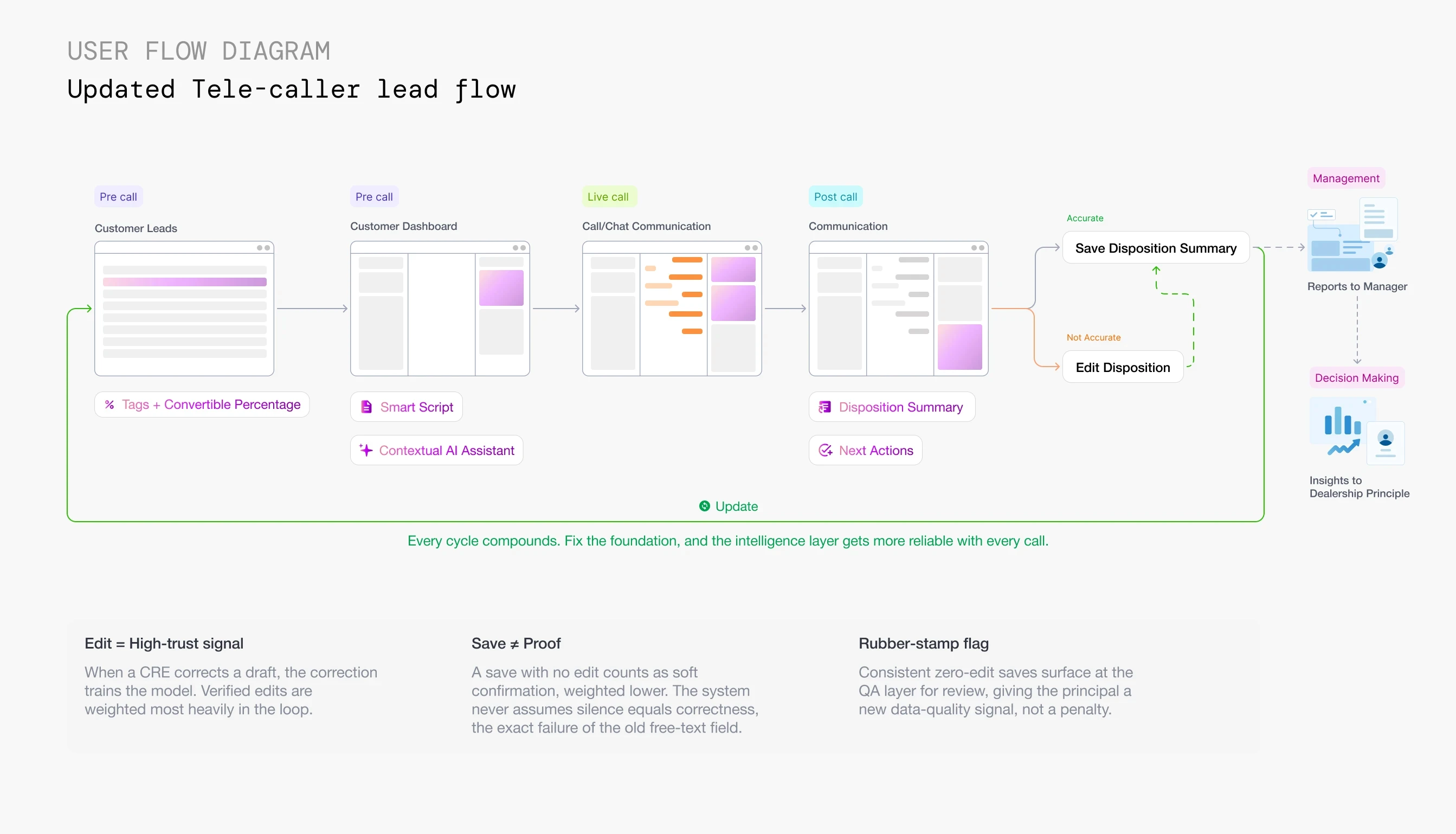
Every cycle compounds. Fix the foundation, and the intelligence layer gets more reliable with every call
DESIGN DECISON 1
Balancing AI Automation and Human Accuracy
Our pilot aimed to collect structured disposition data efficiently. Full auto-tagging by AI was fast but risked silent errors that undermine trust in CRM data. Fully manual forms ensured accuracy but added the admin burden that led to free-text notes initially.
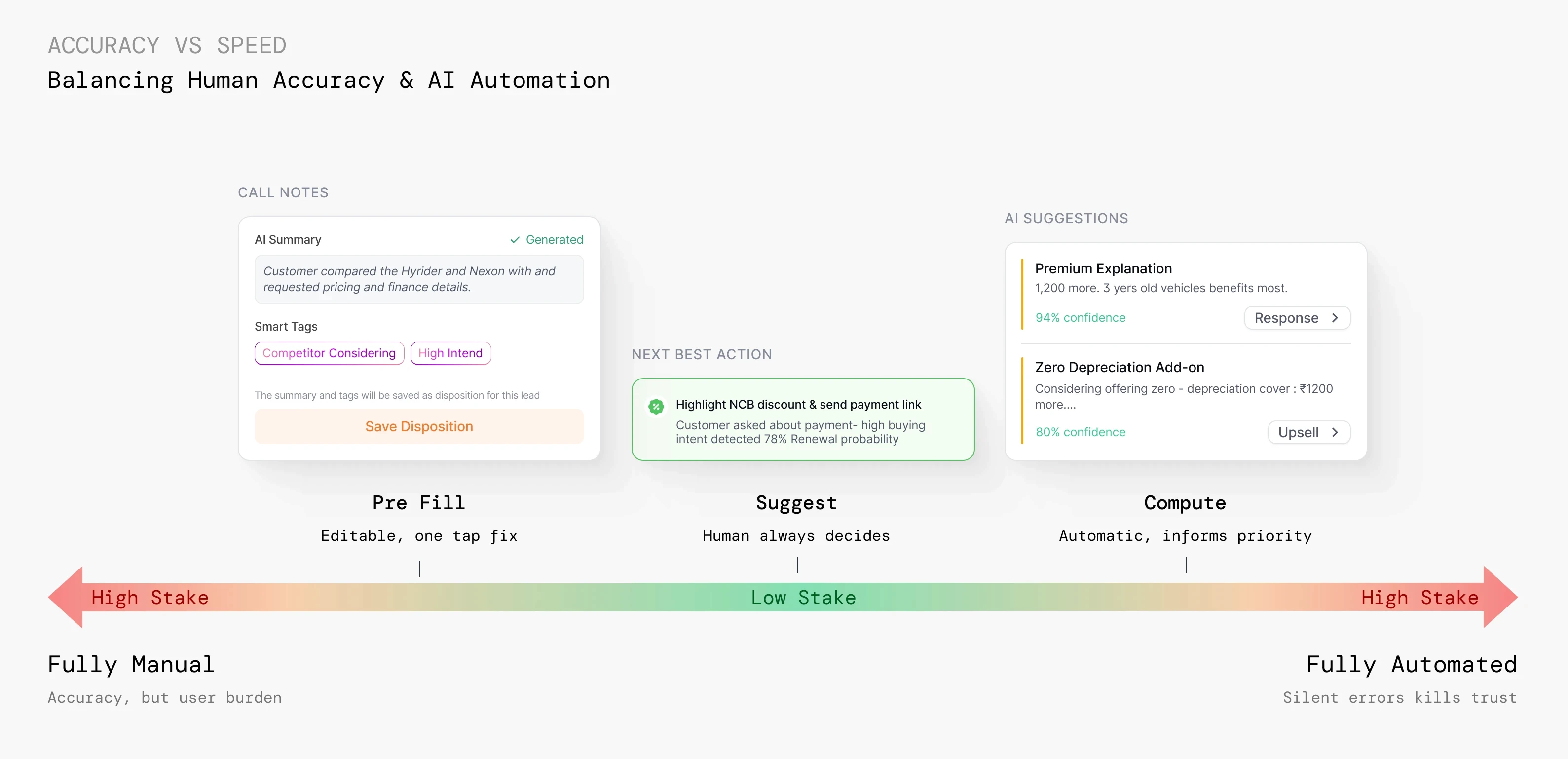
Coverage grows slower than automation would allow, and every confirmation costs the telecaller a moment of attention. this is the tradeoff we accepted:
DESIGN DECISON 2
Inline suggestions not in a sidebar
During calls, the tele caller’s attention is with the customer, so AI never interrupts. The assistant stays in a side panel for the tele caller to access when ready. After the call, AI pushes the insights delivering summaries and suggestions automatically. In both modes, tele callers control actions, they can accept, edit, or ignore AI recommendations.
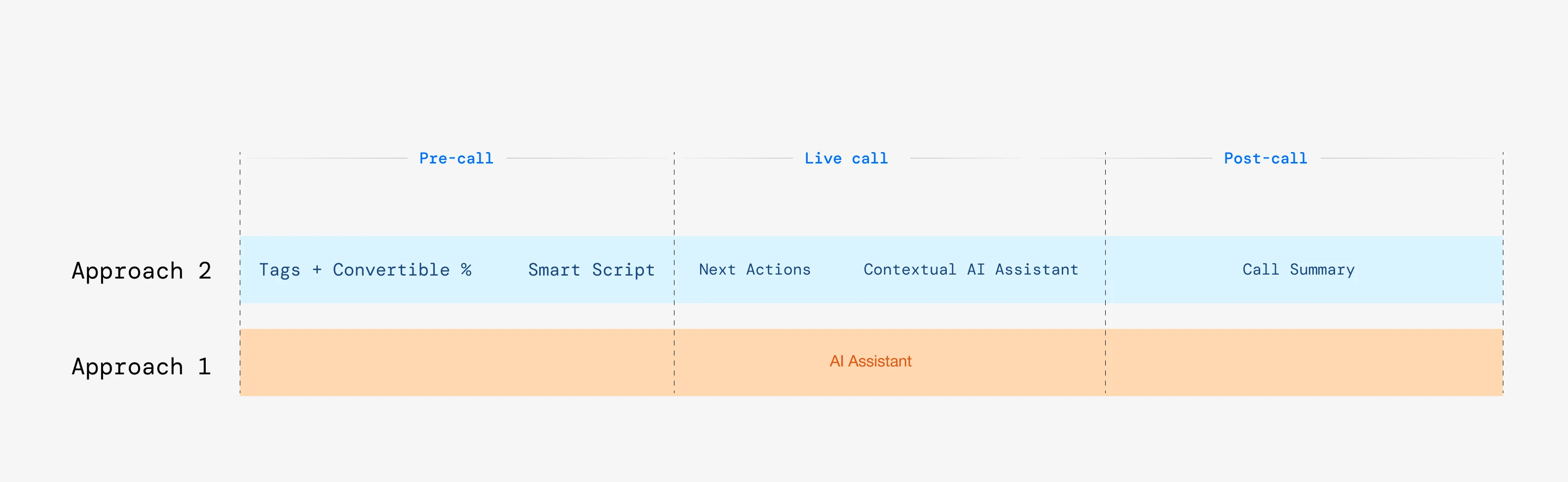
Tradeoffs: Tele caller dont except mid call AI interventions making adaptation a habit forming challenges, we accept to avoid interruptions, the pull model work universally as it is typed input.
Design Prototype
User journey: Lead details → Customer dashboard → Start call → Submit disposition

Pilot Results
We piloted the prototype with one dealership, including 8 Tele callers handling ~100 calls a day, over a week.
7
7
min
Tele Caller Prep Time per Shift
Down from ~7 minutes. Contextual tags and Smart Script surfaced customer context at a glance, instead of forcing tele callers to scan multiple screens before every call.
47%
47%
Disposition Completion Rate
Pilot baseline showed only 47% of dispositions were structured. AI-assisted summaries target 84% at full rollout, the foundation the learning loop depends on.
0%
0%
Tag Adoption Rate
Tele callers accepted or edited 7 in 10 AI-suggested tags during the pilot, with fewer than 15% rejected. Every accept, edit, and rejection feeds back into tag quality.
0
0
session
Principal Dashboard Engagement
Dealership principals shifted from verbal branch updates to reviewing lead intelligence 3–4 times weekly, with at least one action taken from dashboard insights.
Reflections
Designing AI for Real-Time Adoption